
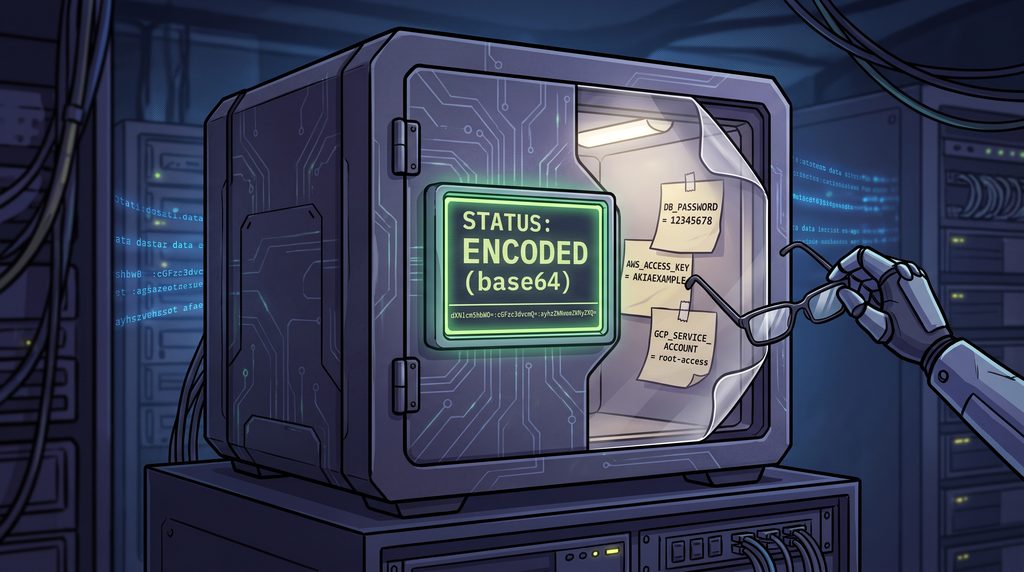
There is a widely accepted practice in modern cloud engineering that is roughly equivalent to writing your ATM pin on your forehead in Pig Latin and assuming you are safe from thieves. I am talking, of course, about the native Kubernetes secret.
If you crack open a standard Kubernetes secret manifest, you will see your database password transformed into a cryptic string of alphanumeric characters. It looks menacing. It feels secure. But it is just base64 encoding. Base64 is not encryption; it is an encoding scheme born in the late 1980s to help primitive mail servers safely transport text files without mangling them. Expecting Base64 to protect your production database credentials is like expecting a paper umbrella to protect you from a meteorite.
Yet, for years, the industry has coasted on this illusion of safety. Anyone with a terminal, broad RBAC permissions, and a passing familiarity with the echo command can decode these secrets in seconds. But the vulnerability does not stop at the API server.
The environmental hazard of the operating system gossip
Let us talk about environment variables. Passing credentials to applications via environment variables has been the default move since the dawn of the twelve factor app. It feels clean. It feels portable. It is also an absolute forensic disaster.
The Linux operating system is a chronic oversharer. Every process has a virtual file sitting at “/proc/$PID/environ”. This file contains every environment variable the process started with, neatly laid out for anyone to see. If your application crashes and dumps its memory, your database password goes with it into the logs. If an APM tool traces a slow transaction, your API keys might hitch a ride into your centralized logging dashboard.
The core objective of modern infrastructure security is surprisingly simple to state and agonizingly difficult to achieve. We must keep credentials off disks, out of environment variables, and away from static storage entirely.
The holy trinity of cloud native credential hygiene
The gold standard for fixing this mess relies on three concepts. Workload Identity, dynamic short-lived secrets, and in-memory injection.
First, we have to stop giving applications permanent passwords. Instead, we use Workload Identity. Think of this as biometric security for your code. The application does not carry a fake ID that says “I am the billing service and here is my password.” Instead, the cloud provider and the Kubernetes cluster establish trust through OIDC (OpenID Connect) federation. The kernel is already playing bouncer; it knows exactly which pod is running which service account. The infrastructure simply looks at the pod and says, “I recognize you, here is a temporary token valid for exactly ten minutes.”
Second, we use dynamic secret generation. If an application truly needs a database password, a tool like HashiCorp Vault or OpenBao intercepts the request, creates a brand new database user with a random password on the fly, and hands it over. The operational headache of manual credential rotation disappears because the credentials expire before anyone even has time to steal them.
Finally, these short-lived tokens are held solely in process memory. There is no file written to disk. There is no environment variable logged. When the pod terminates, the memory evaporates, leaving zero residual traces. The perfect crime, reversed.
Dealing with applications that refuse to evolve
This all sounds wonderful until you meet the real world. The real world is full of legacy applications that stubbornly refuse to speak native cloud identity APIs. They are the digital equivalent of that one uncle who still insists on paying for everything with exact change. They want a file on a disk, or they will simply refuse to start.
When theory crashes into stubborn codebases, we rely on a hierarchy of pragmatic workarounds.
The most elegant trick is using a sidecar or an init container to stream dynamic secrets into a shared memory volume. You tell Kubernetes to mount an emptyDir volume, but you back it with RAM instead of disk storage. The application thinks it is reading a perfectly normal file from a hard drive. In reality, it is reading a holographic projection of a password that exists only in volatile memory. If the server loses power, the secret ceases to exist.
Another popular option is the Secrets Store CSI Driver. This mounts secrets directly from cloud provider key vaults into the pod as files, completely bypassing the native Kubernetes etcd storage. It keeps the files off the permanent cluster disks while maintaining the file semantics the legacy application demands.
And then we have the External Secrets Operator (ESO). ESO is incredibly popular for GitOps workflows because it synchronizes external secrets from a secure vault directly into native Kubernetes secrets. It is highly convenient, but it comes with a caveat. You are still dumping that data into etcd storage. It is better than committing raw secrets to your git repository, but it is functionally similar to locking your front door and leaving the spare key under a very obvious welcome mat.
The uncomfortable conversation with compliance teams
Eventually, you will have to explain your architecture to a security and compliance auditor. This usually triggers an existential debate about where data residency begins and who actually holds the root key.
Compliance teams love hardware security modules (HSMs). They love knowing there is a physical, tamper-proof box in a data center somewhere holding the master key. Moving to a cloud provider’s KMS (Key Management Service) means handing that root trust over to Amazon, Google, or Microsoft.
GitOps engines like ArgoCD force teams to define clear architectural boundaries here. You have to separate the declarative dream of your infrastructure (the code sitting in your repository) from the runtime reality of the cluster. Tools like SOPS allow you to encrypt secrets directly inside your GitOps repositories, moving the security boundary entirely to decryption time.
The path away from plain environment variables is steep, and it requires a fundamental shift in how we think about identity. But continuing to rely on base64 obfuscation and environment variables is no longer a viable strategy. It is time to stop hiding our keys under the mat and start building infrastructure that simply does not need them.