

Changing the default SSH port is one of those pieces of sysadmins advice that keeps getting repeated because it sounds sensible. Port 22 is well known, automated scanners constantly probe it, and moving SSH to something like 2222 makes the server appear a little less obvious.
It also gives you a new port number to remember. That trade-off would be worth discussing if changing the port provided meaningful protection. In most ordinary server setups, it does not. It mostly reduces some automated noise while adding a small amount of friction to your own workflow.
Suppose you move SSH from 22 to 2222. Your connection changes from:
ssh user@serverto:
ssh -p 2222 user@serverYou can, of course, put the port in ~/.ssh/config:
Host foo.bar
    HostName foo.bar
    User user
    IdentityFile ~/.ssh/lorenba
    Port 2222
Now everything works exactly as before, but notice what happened? You changed a perfectly standard configuration, updated your client configuration to compensate for the change, and the bots still have a way to discover the SSH service.
The only obvious benefit is that some scanners looking specifically for port 22 will move on. Is that really worth optimizing?
The illusion of invisibility
Security through obscurity is a bit like hiding your house key under the doormat. It feels clever for about five seconds, right up until you realize that checking under the doormat is the very first thing a burglar will do. Modern port scanners do not just knock on port 22 and call it a day. A tool like Nmap can sweep all 65,535 ports on a machine in the time it takes you to take a sip of coffee. Once the scanner finds an open port, it probes the service. When your server enthusiastically responds with an SSH banner, the gig is up.
You have not hidden the service. You have only slightly delayed its inevitable discovery.
The privileged port problem
There is a more technical quirk to consider, one that often escapes casual observation. In Unix-like operating systems, ports below 1024 are considered “privileged ports.” Only the root user can bind to them. Port 22 falls safely inside this VIP section.
If you move your SSH daemon to a high port, say 2222 or 65000, you are stepping out of the privileged zone. Suppose a malicious actor manages to crash your SSH service, perhaps through an out-of-memory error or a kernel bug. If they have a non-root foothold on your system, they could potentially spin up their own rogue SSH daemon on that high port before your system restarts the legitimate one. Suddenly, you are authenticating against an attacker’s honeypot.
By keeping SSH on port 22, you guarantee that only a process with root privileges can handle your login requests. It is a subtle but foundational layer of trust.
What to do instead of moving the port
If changing the port is a theatrical distraction, how do we actually secure the server? The good news is that the alternatives are far more robust and require zero memorization of arbitrary numbers.
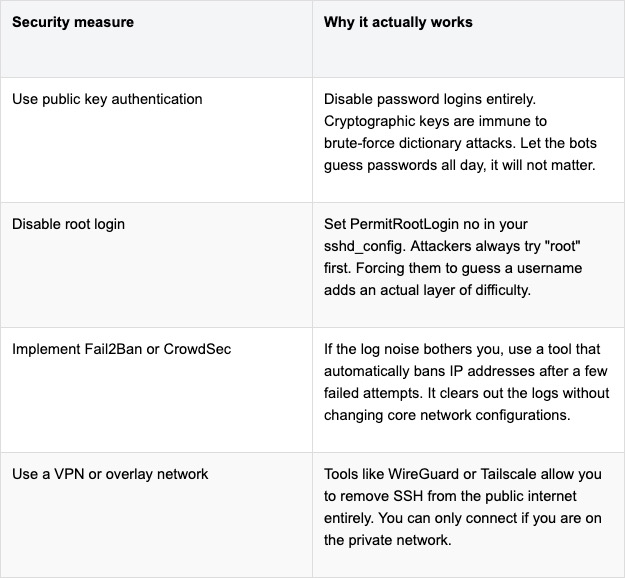
At the end of the day, port 22 is where SSH lives. Leaving it there is not a sign of laziness. It is a sign that you trust your actual security configurations rather than relying on a game of hide and seek.