

ITArchitecture

Cheating the continuous learning meat grinder with AI

Let us consider the cranium of the modern Cloud Architect. It is a finite biological container, roughly the size of a cantaloupe, filled with a squishy mass of fat and water. Yet, the tech industry operates under the hallucination that this cantaloupe can effortlessly absorb the entire AWS service catalog updates before your morning coffee. Trying to ingest the sheer volume of new DevOps tooling is a lot like watching a python try to swallow a double-door refrigerator. It is structurally impossible, deeply uncomfortable to witness, and usually ends with someone needing medical attention. We are practically obligated to evolve constantly, but our neurological hard drives have strict, unyielding limits.

The biological absurdity of keeping up with the CNCF landscape

The concept of “continuous improvement” in IT often feels less like an inspirational corporate poster and more like a slightly sadistic evolutionary mandate. You finally understand the esoteric routing logic of your Kubernetes networking setup. Your heart rate settles. You feel peace. Then, a cheerful newsletter arrives to inform you that your setup is obsolete and someone has thrown a brand new service mesh at your head.

The exhaustion you feel is not a character flaw. It is a standard biological response to an ecosystem that mutates faster than a flu virus in a crowded airport. Our brains were optimized for remembering which berries are poisonous, not for tracking the depreciation schedule of Helm charts.

Stop eating the trendy vegetables you hate

Then there is the fear of missing out, or FOMO, which drives otherwise rational engineers to do deeply irrational things. Let us be brutally honest here. If you absolutely despise Javascript or feel a physical wave of nausea when looking at a shiny new frontend framework, do not force yourself to learn them just because they are trending on Hacker News.

Trying to master disciplines outside your actual interests is like forcing a housecat to take up scuba diving. The cat will hate it, it will do a terrible job, and everyone involved will end up bleeding. Protect your cognitive load with ruthless aggression. As a DevOps professional, you have permission to focus solely on the infrastructure pipelines and Linux kernel quirks that actually bring you joy. Leave the trendy stuff to the people who actually like it.

Enter the hyperactive, infinitely patient robot intern

This brings us to the survival strategy. Artificial intelligence is often pitched as an omniscient overlord coming for our jobs. Right now, however, it is much more useful to view it as a hyperactive, infinitely patient intern. These LLMs exist to do the dirty work our cantaloupe brains reject.

They can read the soul-crushing, poorly translated documentation you desperately want to avoid. You can feed a brutal 50-page technical manual on IAM policies into an AI tool and instruct it to spit out a concise summary directly in your terminal. Or better yet, tell it to explain the concepts to you like you are a tired sysadmin who just wants to go home and play with their Mac. It saves hours of mental decay.

Curating your own survival kit

The trick is learning how to interrogate the AI properly. You do not just ask it “what is new in Terraform.” You demand it to extract the protein from the learning material and throw away the useless fat. You can ask it to summarize release notes, generate highly specific flashcards, or even act as a mock interviewer to test your knowledge on specific CI/CD pipelines before a migration. You are outsourcing the most painful parts of the learning curve to a machine that cannot feel pain or boredom.

The fine art of ignoring things

Ultimately, surviving this industry requires a liberating realization. You simply cannot know everything, and attempting to do so is a biological folly. To truly master the fine art of ignoring things, you need to implement a few practical, slightly ruthless habits.

First, practice strategic amnesia. Stop trying to memorize syntax. If an AI can generate the boilerplate YAML for a Kubernetes deployment in three seconds, your brain should actively refuse to store that information. Treat syntax like a disposable coffee cup; use it once and throw it away.

Second, stop hoarding documentation and start hoarding prompts. Your personal knowledge base should not be a graveyard of unread PDFs. It should be a collection of highly tuned, tested instructions that you can feed into an LLM to get exactly what you need, when you need it. Think of them as spells to summon your robot intern.

Third, politely decline the buffet. When a vendor announces a revolutionary new tool that solves a problem you do not actually have, just nod, smile, and walk away. Your cognitive load is precious cargo. Do not fill the cargo bay with garbage.

The ultimate architectural achievement is not memorizing every obscure command line flag. It is building a well structured mind that understands the core principles and knows exactly how to extract the rest of the answers from an AI assistant. Let the machines hold the heavy encyclopedias. We need our brain space for the truly important mysteries, like figuring out why the production database just mysteriously vanished.
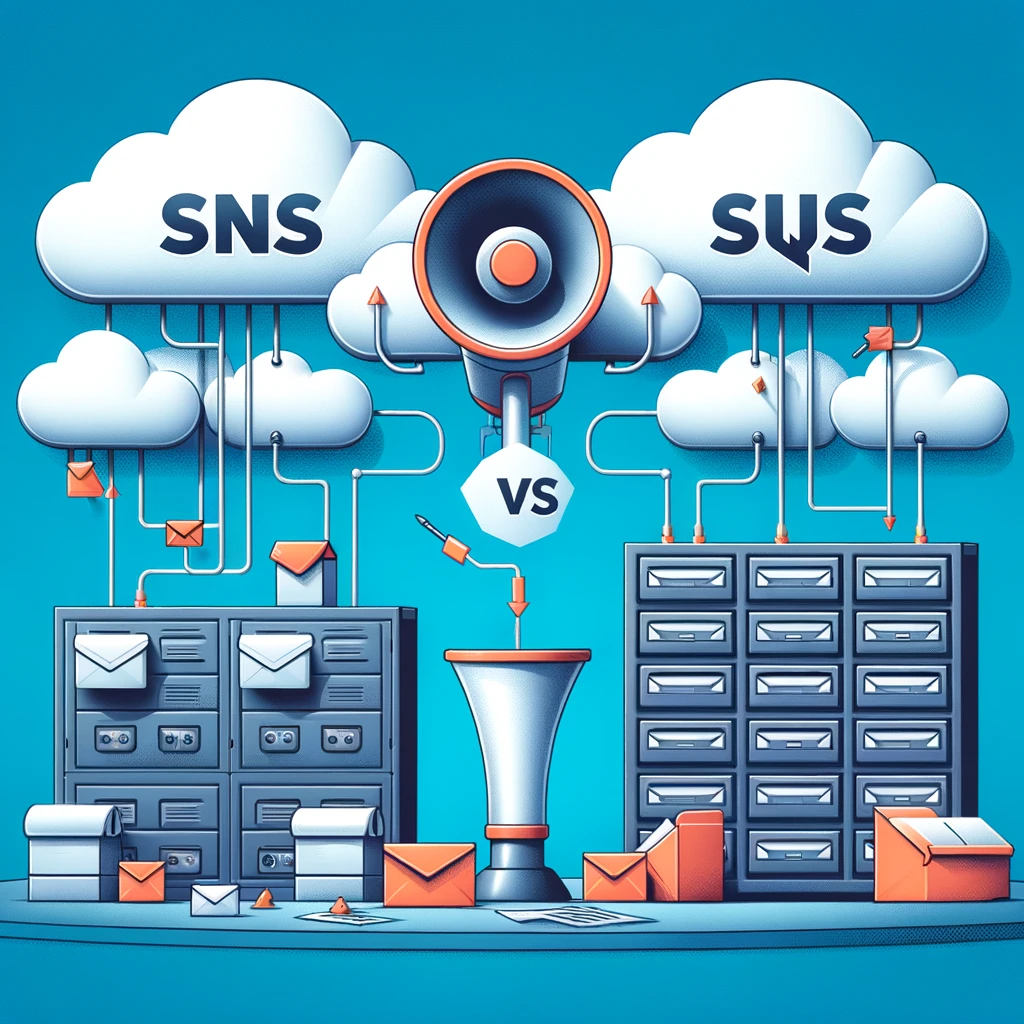
AWS SNS vs SQS. A Practical Guide for DevOps and Cloud Architects

When embarking on the journey of cloud services, particularly within AWS, two critical services often come up for discussion: Simple Notification Service (SNS) and Simple Queue Service (SQS). Both play pivotal roles in message orchestration but serve different purposes.

What Are SNS and SQS?

AWS SNS, a fully managed pub/sub messaging service, excels in scenarios requiring real-time notifications. It is designed to quickly distribute messages to a wide range of subscribers, including both applications (Application-to-Application or A2A) and end-users (Application-to-Person or A2P), through various channels like email, SMS, and push notifications. The strength of SNS lies in its ability to facilitate immediate, push-based communication without persisting messages, making it ideal for time-sensitive information dissemination.

On the other hand, AWS SQS offers a secure, durable, and available hosted queue that lets you integrate and decouple distributed software systems and components. SQS supports at-least-once message delivery, ensuring that no message is lost and allowing for the processing of messages in a flexible manner. Messages in SQS can be persisted for a duration ranging from 1 minute to 14 days, providing a buffer that helps manage workload spikes without losing messages. This makes SQS more suited for scenarios where message processing can be deferred or needs to be distributed across multiple workers for scalability

While both services are powerful on their own, they can also be used together in some scenarios to leverage the benefits of both systems. For instance, using SNS topics to fan out messages to multiple SQS queues enables parallel processing of messages, thereby decoupling and scaling microservices, distributed systems, and serverless applications efficiently.

The choice between AWS SNS and SQS depends on the specific requirements of your application. SNS is your go-to for broadcasting real-time notifications to a wide audience quickly, whereas SQS is better suited for reliable, secure, and scalable message queuing for delayed processing. Understanding the key differences and use cases of these services is crucial for architecting robust, scalable, and efficient cloud-based applications. This introduction aims to provide a comprehensive overview of AWS SNS and SQS, highlighting their distinct features, use cases, and how they can be used together to build scalable and resilient applications.

The Technical Distinction

To delve deeper into the technical differences between AWS SNS and SQS, let’s consider their mechanisms and the implications for system design.

AWS SNS operates on a push-based model, which means that messages are actively sent or “pushed” to all the subscribers as soon as they are published. This immediate, proactive dissemination is useful when an event’s notification is time-sensitive, ensuring that all subscribers can react simultaneously. It’s particularly beneficial when you need to trigger multiple processes in response to a single event.

For instance, in an e-commerce scenario, as soon as a purchase is made, SNS can simultaneously notify inventory management to decrement stock, alert the billing service to invoice, and trigger an email confirmation to the customer. This concurrency is vital for maintaining real-time system responsiveness and is the hallmark of event-driven architectures.

AWS SQS, contrastingly, is based on a pull-based model, which relies on consumers to “poll” or check the queue for messages. This allows for messages to be processed in a controlled manner and at the pace that the consumer can handle. It’s the method of choice when the order of actions is critical, or when the workload needs to be regulated to prevent overloading the system.

For example, in processing transactions, an SQS queue could hold payment information until the fraud detection service is ready to evaluate it, thus preventing a bottleneck. It also allows for scaling as consumer processes can be added or removed according to the queue length, providing a mechanism for workload management.

To summarize, while SNS’s push model excels in immediate, wide-reaching notification, SQS’s pull model provides an orderly, manageable processing queue. The choice between them is not merely technical but strategic, depending on the nature and requirements of the tasks at hand.

A Practical Example: Credit Card Transactions

Imagine a user on an e-commerce site making a purchase. The moment they hit “buy,” a series of orchestrated events unfolds within the platform’s architecture, leveraging AWS’s SNS and SQS services.

Step 1: Transaction Initiation

A user’s purchase request is captured by a transaction processing web service. This service constructs a payload with transaction details such as the transaction ID, customer ID, email, and the amount charged.

Step 2: Credit Card Verification

The service then communicates with a Credit Card Authority Service—like Visa or MasterCard—to validate the transaction. Upon successful validation, the transaction is approved.

Step 3: Event Notification with SNS

This successful transaction is an event of interest to several components. Here, AWS SNS comes into play. The transaction details are published to an SNS topic, which acts like a loudspeaker announcing the event to various subscribed services.

Step 4: Diverse Service Actions

Various services are subscribed to this SNS topic, each with a different role. These include:

  • Customer Reminder Service: A Lambda function that sends a “Thank You” email to the customer.
  • Transaction Analytics Service: Hosted on EC2, this service pulls transaction data from an SQS queue. It’s responsible for updating daily order analytics and revenue calculations.
  • Fraud Detection Service: Also, on EC2, this service polls a separate SQS queue, analyzing transactions for potential fraud.

Each service retrieves information from its SQS queue at its pace, processing the data independently. This decoupling allows for parallel processing and independent scaling, enhancing system reliability and performance.

In this workflow, AWS SNS and SQS demonstrate their unique capabilities. SNS quickly disseminates information to all interested services, while SQS queues allow for orderly and independent processing of events. This synergy is key in crafting a resilient and efficient cloud-based e-commerce architecture.

Choosing Between SNS and SQS

When deciding whether to use SNS or SQS, ask yourself:

  • Do multiple systems need to know about an event immediately? If yes, SNS is your go-to.
  • Does a single system need to process the information of an event on its own schedule? If so, SQS fits the bill.

By utilizing SNS, you can ensure that all interested parties are instantly informed. With SQS, you grant systems the autonomy to process messages without the risk of losing them.

For the DevOps and Cloud Architects

When designing your system’s architecture, considering SNS and SQS is essential for a robust, scalable, and fault-tolerant message-handling framework. These services allow you to decouple your microservices, leading to a more resilient system where failures in one component don’t cascade to others.

Amazon Web Services (AWS) offers two fundamental messaging services: Amazon Simple Notification Service (SNS) and Amazon Simple Queue Service (SQS). SNS is a publish-subscribe messaging service, ideal for applications that need real-time notifications. It supports multiple protocols for message delivery, including email, SMS, HTTP, Lambda functions, and more. On the other hand, SQS is a message queuing service that is more suited for message processing use cases. It can persist messages from 1 minute to 14 days, making it suitable for delayed communication and processing messages in parallel.

The choice between SNS and SQS depends on the specific requirements of your application. SNS is best for broadcasting real-time notifications to a wide audience quickly, while SQS is better suited for reliable, secure, and scalable message queuing for delayed processing. Understanding the key differences and use cases of these services is crucial for architecting robust, scalable, and efficient cloud-based applications.

Architecting the Future: SNS and SQS as Cornerstones

In the domain of cloud architecture, the significance of comprehending and harnessing the capabilities of AWS SNS and SQS cannot be overstated. Whether you find yourself disseminating messages to a broad audience using SNS or ensuring the dependable delivery of messages with SQS, both services form the bedrock of a responsive and effective cloud architecture.

As you venture into the intricacies of these services, it’s crucial to recognize that the selection between SNS and SQS extends beyond the technical domain; it also encapsulates the design philosophy of your system. The fundamental question arises: Do you require notification or queuing? This seemingly simple query serves as a guiding beacon, leading you to the appropriate service, thereby enabling your architecture to flourish in the dynamic realm of AWS.