AIInfrastructure

The social awakening of the Kubernetes scheduler

Human beings are notoriously bad at coordination, but we like to think our machines are better. They are not. For over a decade, Kubernetes, the undisputed king of cloud orchestration, has behaved like a blind restaurant host with a severe case of short-term memory loss.

If you arrived at this restaurant with a party of eight, the host would not look for a table of eight. Instead, they would grab the first person in your group, lead them to a random single stool in the corner, and tell them to wait. Then they would grab the second person and squeeze them between two strangers at the bar. If the remaining guests could not find seats, the host would simply shrug. The first seven would sit there forever, nursing their half-empty glasses of water, while the last person stood shivering in the rain outside.

In computer science, we call this tragedy a scheduling deadlock. In Kubernetes, it is just another Tuesday. But with the release of version 1.36, the system is finally learning some manners through a set of features known as workload-aware scheduling.

The tragedy of scheduling one shoe at a time

Historically, Kubernetes was designed to think in terms of individual pods. To the scheduler, a pod is a single, solitary unit of life, like a lonely left shoe. It does not know or care if there is a right shoe waiting in the queue. It just wants to put the left shoe on a foot, even if the owner of that foot has no legs.

This single-minded approach works beautifully for simple web servers. If you need ten copies of an application, they do not need to know each other. They do not talk, they do not share secrets, and they certainly do not need to hold hands.

But modern workloads, particularly those driving artificial intelligence, machine learning, and massive mathematical calculations, are different. They do not run on lonely, independent pods. They run on highly codependent troupes of containers that must work together or not at all. If you are running an eight-GPU training job, you might need all eight nodes to start at exactly the same microsecond. If seven show up and the eighth is stuck in the hallway because a node ran out of memory, the entire operation grinds to a halt. The active pods just sit there, chewing up expensive processor cycles and doing absolutely nothing useful.

To fix this, the open-source community decided to give Kubernetes some social intelligence. They wanted to teach the system how to recognize a group of friends and seat them all together.

Enter the PodGroup, a unit of social cohesion

To bring order to this chaos, Kubernetes v1.36 introduces a clever piece of psychological separation. It splits the concept of a multi-pod job into two distinct entities, namely a static blueprint called the Workload API and an active, fast-moving runtime object called the PodGroup API.

The separation is brilliant in its boringness. Imagine trying to coordinate a huge family reunion. The Workload is the official invitation list, a static piece of paper detailing who should theoretically show up. The PodGroup is the group text message where everyone argues in real-time about who is actually arriving, who is running late, and who went to the wrong address.

If the scheduler had to update the master blueprint every single time a single pod changed its status, the central API server would suffer the digital equivalent of a massive nervous breakdown. By keeping the blueprint quiet and letting the temporary PodGroup handle the frantic, fast-moving status updates, the system avoids data congestion. It is the architectural equivalent of having a calm office manager who handles the contracts while an assistant runs around screaming with a clipboard.

A basic PodGroup declaration is surprisingly simple, containing just enough information to tell the scheduler how many members actually make a quorum.

apiVersion: scheduling.k8s.io/v1alpha2
kind: PodGroup
metadata:
  name: neural-training-crew
spec:
  minMember: 8

In this little snippet, we are telling Kubernetes that unless all eight of our digital family members can be seated at the table at the exact same time, nobody gets seated at all. The scheduler takes one clean snapshot of the system and commits the whole gang, or nothing. It is, quite literally, collective bargaining for containers.

The art of polite eviction

Of course, life in the cloud is rarely empty. Most of the time, your cluster is already full of small, low-priority pods doing things like sending promotional emails or logging the temperature of the server room.

When your giant, expensive AI training workload arrives at the door, it needs space immediately. In the old days, the scheduler would look at the crowded room, see that there was no space for a group of eight pods, and simply give up.

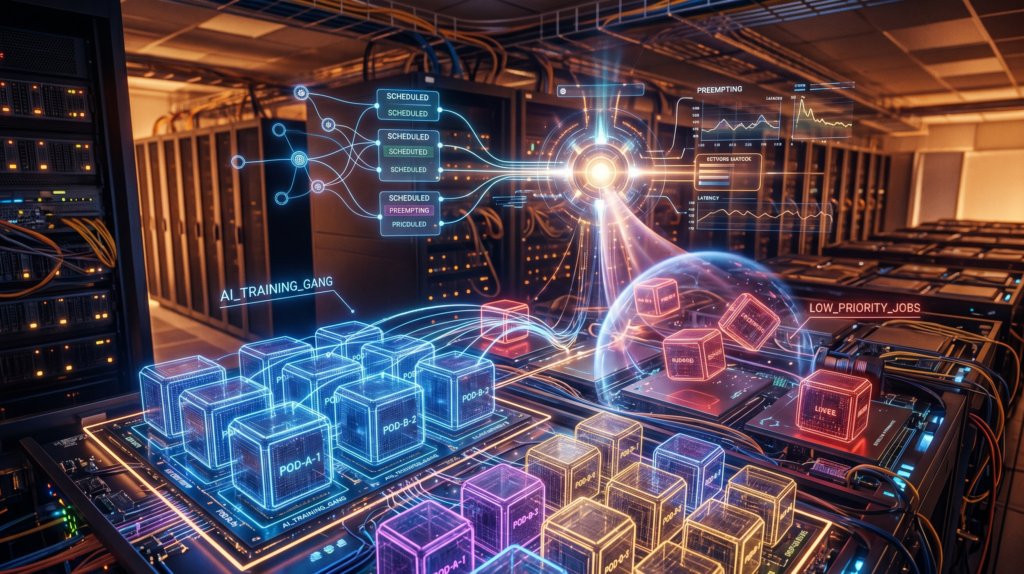
With workload-aware preemption, the scheduler gains a more assertive personality. Instead of looking at individual pods, it evaluates the entire PodGroup as a single, powerful entity. If the group cannot fit, the scheduler can look at the low-priority pods currently occupying the nodes and decide to evict them.

Crucially, this is controlled by a setting called the disruptionMode. You can configure your PodGroup so that if it must be interrupted, it happens as an all-or-nothing event. Your pods can either be evicted one by one, or they can refuse to leave unless the entire group is taken down together, holding hands in a dramatic show of solidarity. This prevents a situation where half of your training job is evicted, leaving the remaining half running uselessly and burning through your cloud budget.

Putting the family in the same neighborhood

There is one final piece to this scheduling puzzle. In the world of high-performance computing, physical distance matters. If your pods are communicating constantly, placing half of them in an Oregon data center and the other half in Virginia is a recipe for terrible latency. It is like trying to have a conversation where every sentence takes three seconds to travel across the room.

To solve this, Kubernetes v1.36 introduces topology-aware workload scheduling. This ensures that the scheduler does not just find enough seats for your pods, but actually finds them close to one another, preferably on the same network switch, the same rack, or even the same physical machine.

It is the equivalent of booking hotel rooms for your family reunion and ensuring that everyone is on the third floor, rather than scattered across five different buildings in different zip codes.

A short conclusion for the caffeinated reader

We have spent years treating containers like isolated, disposable little boxes. We launched them, forgot about them, and let them fend for themselves. But as our software grows more complex and our artificial intelligence models require more computational power, we are discovering that our containers need to cooperate.

The changes in Kubernetes v1.36 are not just minor performance tweaks. They represent a fundamental shift in how the system understands work. By teaching the scheduler how to recognize groups, respect their physical proximity, and evict them gracefully, Kubernetes is growing up. It is no longer just a system for running individual applications. It is becoming a highly sophisticated, socially aware coordinator for the most complex computational tasks on the planet. And that is definitely worth raising a coffee mug to.

SRE in the age of generative AI

Imagine this: you’re a seasoned sailor, a master of the seas, confident in navigating any storm. But suddenly, the ocean beneath your ship becomes a swirling vortex of unpredictable currents and shifting waves. Welcome to Site Reliability Engineering (SRE) in the age of Generative AI.

The shifting tides of SRE

For years, SREs have been the unsung heroes of the tech world, ensuring digital infrastructure runs as smoothly as a well-oiled machine. They’ve refined their expertise around automation, monitoring, and observability principles. But just when they thought they had it all figured out, Generative AI arrived, turning traditional practices into a tsunami of new challenges.

Now, imagine trying to steer a ship when the very nature of water keeps changing. That’s what it feels like for SREs managing Generative AI systems. These aren’t the predictable, rule-based programs of the past. Instead, they’re complex, inscrutable entities capable of producing outputs as unpredictable as the weather itself.

Charting unknown waters, the challenges

The black box problem

Think of the frustration you feel when trying to understand a cryptic message from someone close to you. Multiply that by a thousand, and you’ll begin to grasp the explainability challenge in Generative AI. These models are like giant, moody teenagers, powerful, complex, and often inexplicable. Even their creators sometimes struggle to understand them. For SREs, debugging these black-box systems can feel like trying to peer into a locked room without a key.

Here, SREs face a pressing need to adopt tools and practices like ModelOps, which provide transparency and insights into the internal workings of these opaque systems. Techniques such as SHAP (Shapley Additive Explanations) and LIME (Local Interpretable Model-agnostic Explanations) are becoming increasingly important for addressing this challenge.

The fairness tightrope

Walking a tightrope while juggling flaming torches, that’s what ensuring fairness in Generative AI feels like. These models can unintentionally perpetuate or even amplify societal biases, transforming helpful tools into unintentional discriminators. SREs must be constantly vigilant, using advanced techniques to audit models for bias. Think of it like teaching a parrot to speak without picking up bad language, seemingly simple but requiring rigorous oversight.

Frameworks like AI Fairness 360 and Explainable AI are vital here, giving SREs the tools to ensure fairness is baked into the system from the start. The task isn’t just about keeping the models accurate, it’s about ensuring they remain ethical and equitable.

The hallucination problem

Imagine your GPS suddenly telling you to drive into the ocean. That’s the hallucination problem in Generative AI. These systems can occasionally produce outputs that are convincingly wrong, like a silver-tongued con artist spinning a tale. For SREs, this means ensuring systems not only stay up and running but that they don’t confidently spout nonsense.

SREs need to develop robust monitoring systems that go beyond the typical server loads and response times. They must track model outputs in real-time to catch hallucinations before they become business-critical issues. For this, leveraging advanced observability tools that monitor drift in outputs and real-time hallucination detection will be essential.

The scalability scramble

Managing Generative AI models is like trying to feed an ever-growing, always-hungry giant. Large language models, for example, are resource-hungry and demand vast computational power. The scalability challenge has pushed even the most hardened IT professionals into a constant scramble for resources.

But scalability is not just about more servers; it’s about smarter allocation of resources. Techniques like horizontal scaling, elastic cloud infrastructures, and advanced resource schedulers are critical. Furthermore, AI-optimized hardware such as TPUs (Tensor Processing Units) can help alleviate the strain, allowing SREs to keep pace with the growing demands of these AI systems.

Adapting the sails, new approaches for a new era

Monitoring in 4D

Traditional monitoring tools, which focus on basic metrics like server performance, are now inadequate, like using a compass in a magnetic storm. In this brave new world, SREs are developing advanced monitoring systems that track more than just infrastructure. Think of a control room that not only shows server loads and response times but also real-time metrics for bias drift, hallucination detection, and fairness checks.

This level of monitoring requires integrating AI-specific observability platforms like OpenTelemetry, which offer more comprehensive insights into the behavior of models in production. These tools give SREs the ability to manage the dynamic and often unpredictable nature of Generative AI.

Automation on steroids

In the past, SREs focused on automating routine tasks. Now, in the world of GenAI, automation needs to go further, it must evolve. Imagine self-healing, self-evolving systems that can detect model drift, retrain themselves, and respond to incidents before a human even notices. This is the future of SRE: infrastructure that can adapt in real time to ever-changing conditions.

Frameworks like Kubernetes and Terraform, enhanced with AI-driven orchestration, allow for this level of dynamic automation. These tools give SREs the power to maintain infrastructure with minimal human intervention, even in the face of constant change.

Testing in the Twilight Zone

Validating GenAI systems is like proofreading a book that rewrites itself every time you turn the page. SREs are developing new testing paradigms that go beyond simple input-output checks. Simulated environments are being built to stress-test models under every conceivable (and inconceivable) scenario. It’s not just about checking whether a system can add 2+2, but whether it can handle unpredictable, real-world situations.

New tools like DeepMind’s AlphaCode are pushing the boundaries of testing, creating environments where models are continuously challenged, ensuring they perform reliably across a wide range of scenarios.

The evolving SRE, part engineer, part data Scientist, all superhero

Today’s SRE is evolving at lightning speed. They’re no longer just infrastructure experts; they’re becoming part data scientist, part ethicist, and part futurist. It’s like asking a car mechanic to also be a Formula 1 driver and an environmental policy expert. Modern SREs need to understand machine learning, ethical AI deployment, and cloud infrastructure, all while keeping production systems running smoothly.

SREs are now a crucial bridge between AI researchers and the real-world deployment of AI systems. Their role demands a unique mix of skills, including the wisdom of Solomon, the patience of Job, and the problem-solving creativity of MacGyver.

Gazing into the crystal ball

As we sail into this uncharted future, one thing is clear: the role of SREs in the age of Generative AI is more critical than ever. These engineers are the guardians of our AI-powered future, ensuring that as systems become more powerful, they remain reliable, fair, and beneficial to society.

The challenges are immense, but so are the opportunities. This isn’t just about keeping websites running, it’s about managing systems that could revolutionize industries like healthcare and space exploration. SREs are at the helm, steering us toward a future where AI and human ingenuity work together in harmony.

So, the next time you chat with an AI that feels almost human, spare a thought for the SREs behind the scenes. They are the unsung heroes ensuring that our journey into the AI future is smooth, reliable, and ethical. In the age of Generative AI, SREs are not just reliability engineers, they are the navigators of our digital destiny.