

DataPipelines

Why generic auto scaling is terrible for healthcare pipelines

Let us talk about healthcare data pipelines. Running high volume payer processing pipelines is a lot like hosting a mandatory potluck dinner for a group of deeply eccentric people with severe and conflicting dietary restrictions. Each payer behaves with maddening uniqueness. One payer bursts through the door, demanding an entire roasted pig, which they intend to consume in three minutes flat. This requires massive, short-lived computational horsepower. Another payer arrives with a single boiled pea and proceeds to chew it methodically for the next five hours, requiring a small but agonizingly persistent trickle of processing power.

On top of this culinary nightmare, there are strict rules of etiquette. You absolutely must digest the member data before you even look at the claims data. Eligibility files must be validated before anyone is allowed to touch the dessert tray of downstream jobs. The workload is not just heavy. It is incredibly uneven and delightfully complicated.

Buying folding chairs for a banquet

On paper, Amazon Web Services managed Auto Scaling Mechanisms should fix this problem. They are designed to look at a growing pile of work and automatically hire more help. But applying generic auto scaling to healthcare pipelines is like a restaurant manager seeing a line out the door and solving the problem by buying fifty identical plastic folding chairs.

The manager does not care that one guest needs a high chair and another requires a reinforced steel bench. Auto scaling reacts to the generic brute force of the system load. It cannot look at a specific payer and tailor the compute shape to fit their weird eating habits. It cannot enforce the strict social hierarchy of job priorities. It scales the infrastructure, but it completely fails to scale the intention.

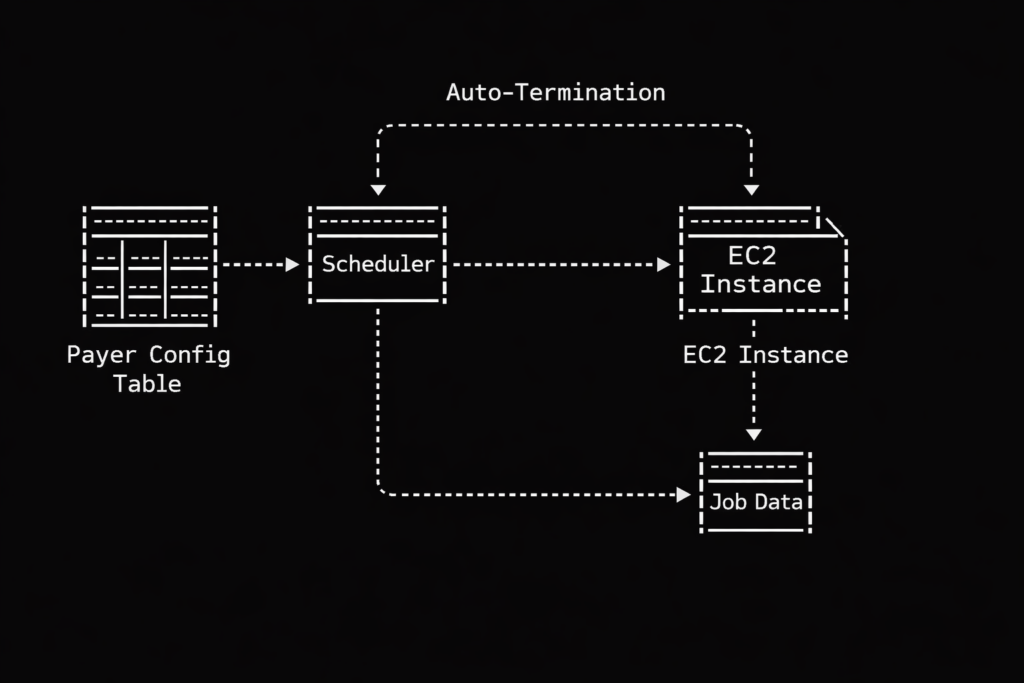
This is why we abandoned the generic approach and built our own dynamic EC2 provisioning system. Instead of maintaining a herd of generic servers waiting around for something to do, we create bespoke servers on demand based on a central configuration table.
The ruthless nightclub bouncer of job scheduling

Let us look at how this actually works regarding prioritization. Our system relies on that central configuration table to dictate order. Think of this table as the guest list at an obnoxiously exclusive nightclub. Our scheduler acts as the ruthless bouncer.

When jobs arrive at the queue, the bouncer checks the list. Member data? Right this way to the VIP lounge, sir. Claims data? Stand on the curb behind the velvet rope until the members are comfortably seated. Generic auto scaling has no native concept of this social hierarchy. It just sees a mob outside the club and opens the front doors wide. Our dynamic approach gives us perfect, tyrannical control over who gets processed first, ensuring our pipelines execute in a beautifully deterministic way. We spin up exactly the compute we specify, exactly when we want it.

Leaving your car running in the garage

Then there is the financial absurdity of warm pools. Standard auto scaling often relies on keeping a baseline of idle instances warm and ready, just in case a payer decides to drop a massive batch of files at two in the morning.

Keeping idle servers running is the technological equivalent of leaving your car engine idling in the closed garage all night just in case you get a sudden craving for a carton of milk at dawn. It is expensive, it is wasteful, and it makes you look a bit foolish when the AWS bill arrives.

Our dynamic system operates with a baseline of zero. We experience one hundred percent burst efficiency because we only pay for the exact compute we use, precisely when we use it. Cost savings happen naturally when you refuse to pay for things that are sitting around doing nothing.

A delightfully brutal server lifecycle

The operational model we ended up with is almost comically simple compared to traditional methods. A generic scaling group requires complex scaling policies, tricky cooldown periods, and endless tweaking of CloudWatch alarms. It is like managing a highly sensitive, moody teenager.

Our dynamic EC2 model is wonderfully ruthless. We create the instance and inject it with a single, highly specific purpose via a startup script. The instance wakes up, processes the healthcare data with absolute precision, and then politely self destructs so it stops billing us. They are the mayflies of the cloud computing world. They live just long enough to do their job, and then they vanish. There are no orphaned instances wandering the cloud.

This dynamic provisioning model has fundamentally altered how we digest payer workloads. We have somehow achieved a weird but perfect holy grail of cloud architecture. We get the granular flexibility of serverless functions, the raw, unadulterated horsepower of dedicated EC2 instances, and the stingy cost efficiency of a pure event-driven design.

If your processing jobs vary wildly from payer to payer, and if you care deeply about enforcing priorities without burning money on idle metal, building a disposable compute army might be exactly what your architecture is missing. We said goodbye to our idle servers, and honestly, we do not miss them at all.


What exactly is Data Engineering

The world today runs on data. Every click, purchase, or message we send creates data, and we’re practically drowning in it. However, raw data alone isn’t helpful. Data engineering transforms this flood of information into valuable insights.

Think of data as crude oil. It is certainly valuable, but in its raw form, it’s thick, messy goo. It must be refined before it fuels anything useful. Similarly, data needs processing before it can power informed decisions. This essential refinement process is exactly what data engineering does, turning chaotic, raw data into structured, actionable information.

Without data engineering, businesses face data chaos; analysts might wait endlessly for data, or executives might make decisions blindly without reliable information. Good data engineering eliminates these issues, ensuring data flows efficiently and reliably.

Understanding what Data Engineering is

Data engineering is the hidden machinery that makes data useful for analysis. It involves building robust pipelines, efficient storage solutions, diligent data cleaning, and thorough preparation. Everything needed to move data from its source to its destination neatly and effectively.

A good data engineer is akin to a plumber laying reliable pipes, a janitor diligently cleaning up messes, and an architect ensuring the entire system remains stable and scalable. They create critical infrastructure that data scientists and analysts depend on daily.

Journey of a piece of data

Data undergoes an intriguing journey from creation to enabling insightful decisions. Let’s explore this journey step by step:

Origin of Data

Data arises everywhere, continuously and relentlessly:

  • People interacting with smartphones
  • Sensors operating in factories
  • Transactions through online shopping
  • Social media interactions
  • Weather stations reporting conditions

Data arrives continuously in countless formats, structured data neatly organized in tables, free-form text, audio, images, or even streaming video.

Capturing the Data

Effectively capturing this torrent of information is critical. Data ingestion is like setting nets in a fast-flowing stream, carefully catching exactly what’s needed. Real-time data, such as stock prices, requires immediate capture, while batch data, like daily sales reports, can be handled more leisurely.

The key challenge is managing diverse data formats and varying speeds without missing crucial information.

Finding the Right Storage

Captured data requires appropriate storage, typically in three main types:

  • Databases (SQL): Structured repositories for transactional data, like MySQL or PostgreSQL.
  • Data Lakes: Large, flexible storage systems such as Amazon S3 or Azure Data Lake, storing raw data until it’s needed.
  • Data Warehouses: Optimized for rapid analysis, combining organizational clarity and flexibility, exemplified by platforms like Snowflake, BigQuery, and Redshift.

Choosing the right storage solution depends on intended data use, volume, and accessibility requirements. Effective storage ensures data stays secure, readily accessible, and scalable.

Transforming Raw Data

Raw data often contains inaccuracies like misspelled names, incorrect date formats, duplicate records, and missing information. Data processing cleans and transforms this messy data into actionable insights. Processing might involve:

  • Integrating data from multiple sources
  • Computing new, derived fields
  • Summarizing detailed transactions
  • Normalizing currencies and units
  • Extracting features for machine learning

Through careful processing, data transforms from mere potential into genuine value.

Extracting Valuable Insights

This stage brings the real payoff. Organized and clean data allows analysts to detect trends, enables data scientists to create predictive models, and helps executives accurately track business metrics. Effective data engineering streamlines this phase significantly, providing reliable and consistent results.

Ensuring Smooth Operations

Data systems aren’t “set and forget.” Pipelines can break, formats can evolve, and data volumes can surge unexpectedly. Continuous monitoring identifies issues early, while regular maintenance ensures everything runs smoothly.

Exploring Data Storage in greater detail

Let’s examine data storage options more comprehensively:

Traditional SQL Databases

Relational databases such as MySQL and PostgreSQL remain powerful because they:

  • Enforce strict rules for clean data
  • Easily manage complex relationships
  • Ensure reliability through ACID properties (Atomicity, Consistency, Isolation, Durability)
  • Provide SQL, a powerful querying language

SQL databases are perfect for transactional systems like banking or e-commerce platforms.

Versatile NoSQL Databases

NoSQL databases emerged to manage massive data volumes flexibly and scalably, with variants including:

  • Document Databases (MongoDB): Ideal for semi-structured or unstructured data.
  • Key-Value Stores (Redis): Perfect for quick data access and caching.
  • Graph Databases (Neo4j): Excellent for data rich in relationships, like social networks.
  • Column-Family Databases (Cassandra): Designed for high-volume, distributed data environments.

NoSQL databases emphasize scalability and flexibility, often compromising some consistency for better performance.

Selecting Between SQL and NoSQL

There isn’t a universally perfect choice; decisions depend on specific use cases:

  • Choose SQL when data structure remains stable, consistency is critical, and relationships are complex.
  • Choose NoSQL when data structures evolve quickly, scalability is paramount, or data is distributed geographically.

The CAP theorem helps balance consistency, availability, and partition tolerance to guide this decision.

Mastering the ETL process

ETL (Extract, Transform, Load) describes moving data efficiently from source systems to analytical environments:

Extract

Collect data from various sources like databases, APIs, logs, or web scrapers.

Transform

Cleanse and structure data by removing inaccuracies, standardizing formats, and eliminating duplicates.

Load

Move processed data into analytical systems, either by fully refreshing or incrementally updating.

Modern tools like Apache Airflow, NiFi, and dbt greatly enhance the efficiency and effectiveness of the ETL process.

Impact of cloud computing

Cloud computing has dramatically reshaped data engineering. Instead of maintaining costly infrastructure, businesses now rent exactly what’s needed. Cloud providers offer complete solutions for:

  • Data ingestion
  • Scalable storage
  • Efficient processing
  • Analytical warehousing
  • Visualization and reporting

Cloud computing offers instant scalability, cost efficiency, and access to advanced technology, allowing engineers to focus on data challenges rather than infrastructure management. Serverless computing further simplifies this process by eliminating server-related concerns.

Essential tools for Data Engineers

Modern data engineers use several essential tools, including:

  • Python: Versatile and practical for various data tasks.
  • SQL: Crucial for structured data queries.
  • Apache Spark: Efficiently processes large datasets.
  • Apache Airflow: Effectively manages complex data pipelines.
  • dbt: Incorporates software engineering best practices into data transformations.

Together, these tools form reliable and robust data systems.

The future of Data Engineering

Data engineering continues to evolve rapidly:

  • Real-time data processing is becoming standard.
  • DataOps encourages collaboration and automation.
  • Data mesh decentralizes data ownership.
  • MLOps integrates machine learning models seamlessly into production environments.

Ultimately, effective data engineering ensures reliable and efficient data flow, crucial for informed business decisions.

Summarizing

Data engineering may lack glamour, but it serves as the essential backbone of modern organizations. Without it, even the most advanced data science projects falter, resulting in misguided decisions. Reliable data engineering ensures timely and accurate data delivery, empowering analysts, data scientists, and executives alike. As businesses become increasingly data-driven, strong data engineering capabilities become not just beneficial but essential for competitive advantage and sustainable success.

In short, investing in excellent data engineering is one of the most strategic moves an organization can make.