
CloudCosts

Chronicle of a death foretold for the EFK stack in high demand environments

Your monthly cloud infrastructure bill arrives in your inbox. You open the PDF document, and suddenly your left eyelid starts twitching uncontrollably. The finance department has started leaving passive-aggressive sticky notes on your monitor. You realize you are spending the equivalent of a small nation’s gross domestic product just to store text files that repeat “INFO: User logged in” three billion times a day. Welcome to the modern logging crisis.

For years, the Kubernetes logging ecosystem was basically on autopilot. You installed the EFK stack (Elasticsearch, Fluentd, and Kibana), and it just worked. It was the safest default in the industry. But as we navigate through 2026, something has fundamentally ruptured. EFK did not suddenly become toxic waste overnight. It simply became the victim of its own architecture in an era where log volumes have mutated into unrecognizable monsters.

The shift away from EFK is not driven by shiny object syndrome. It is driven by raw economics, hardware exhaustion, and the very human desire not to wake up sweating at 3 AM because a logging cluster ran out of disk space.

The golden retriever in the sausage factory

Let us start with Fluentd. Fluentd is incredibly stable, highly flexible, and has served the community well. However, it is written in Ruby.

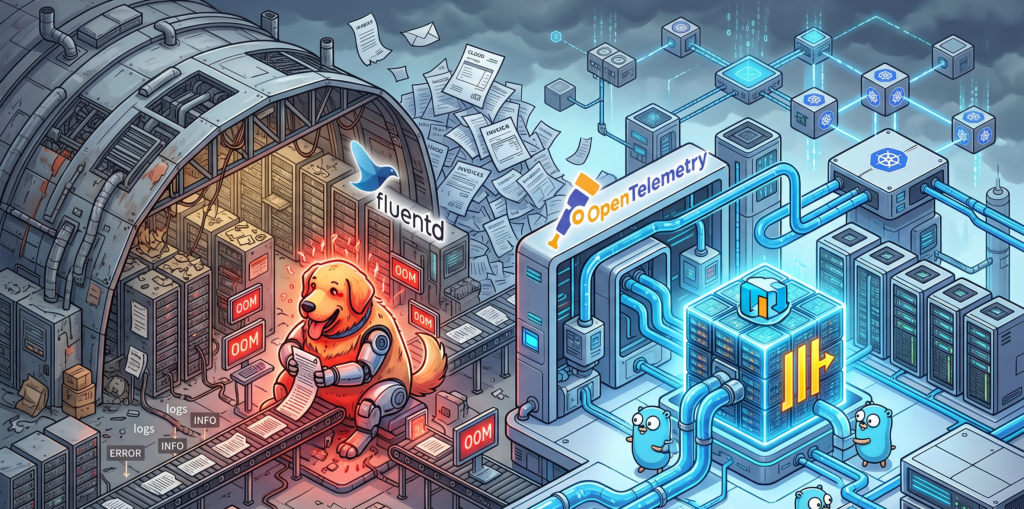
Under moderate loads, Fluentd is a perfectly polite guest. But when you expose it to the high-demand environments of modern microservices, Fluentd exhibits the same impulse control as an unsupervised Golden Retriever locked inside a sausage factory. It just eats all your available CPU and RAM until it physically cannot hold any more, burps an Out Of Memory error, and then politely demands that you scale it horizontally.

This operational overhead becomes exhausting. The industry needed something leaner. Enter the OpenTelemetry Collector. Written in Go, it processes telemetry data with the cold, calculated efficiency of an IRS auditor. It handles metrics, traces, and logs in a unified pipeline without treating your server’s memory like an all you can eat buffet.

Here is what a modern, lightweight pipeline configuration looks like today, completely devoid of Ruby overhead:

# OpenTelemetry Collector routing logs without eating your RAM
receivers:
  filelog:
    include: [ /var/log/pods/*/*/*.log ]
exporters:
  clickhouse:
    endpoint: tcp://clickhouse-server:9000
    database: observability
service:
  pipelines:
    logs:
      receivers: [filelog]
      exporters: [clickhouse]

Packing your socks in industrial hangars

The real villain in your cloud bill, however, is not the collector. It is the storage layer. Elasticsearch is an absolute marvel of engineering if you are trying to build a complex search engine for an e-commerce website. But using it exclusively to store application logs is an architectural tragedy.

Storing logs in Elasticsearch is like packing a single pair of socks in an individual cardboard box, wrapping that box in three layers of industrial bubble wrap, and attaching a GPS tracker to it. Yes, the inverted index structure guarantees that you will find those specific socks at the speed of light. But your luggage now occupies three entire aviation hangars, and the monthly rent is absurd. The indexing process creates massive data bloat, multiplying your storage footprint and your anxiety levels simultaneously.

The bouillon cube of observability

This is where ClickHouse enters the scene and aggressively rewrites the rules. ClickHouse looks at your three hangars full of bubble-wrapped socks, throws them into an industrial shredder, and compresses the resulting mass into a super dense data bouillon cube.

ClickHouse relies on columnar storage and sparse indexes. It does not index every single word of your log lines. Instead, it compresses the data so tightly that your storage footprint shrinks to a fraction of what EFK required. And because developers already dream in SQL, querying this massive block of data feels entirely natural.

Instead of wrestling with Kibana’s proprietary query language just to find out why a payment failed, your team can simply run a query like this:

-- Finding errors without going bankrupt
SELECT
    toStartOfMinute(timestamp) AS minute,
    count() AS total_errors,
    dictGet('services', 'name', service_id) AS service_name
FROM application_logs
WHERE level = 'ERROR' AND timestamp > now() - INTERVAL 1 HOUR
GROUP BY minute, service_name
ORDER BY minute DESC;

Grafana sits on top of this SQL engine like a happy gargoyle, providing the exact same dashboarding capabilities you used to get from Kibana, but with the added benefit of seamlessly linking your logs directly to your OpenTelemetry metrics and traces.

Swapping tires on the highway

Now, a word of caution. The worst thing you can do after reading this is to march into your office and delete your Elasticsearch cluster.

Transitioning from EFK to the OpenTelemetry and ClickHouse stack overnight is the IT equivalent of trying to change your car tires while driving at 120 miles per hour down the highway. You will almost certainly lose the chassis in the process.

A migration requires a gradual cutover. You must deploy the OpenTelemetry Collector alongside your existing Fluentd setup. Route a small subset of non critical logs to ClickHouse. Compare the ingestion rates. Let your team practice writing SQL queries to find errors. Only when you are confident that the bouillon cube is holding its shape should you start decommissioning the old, expensive hangars.

When to completely ignore my advice

To be perfectly fair, EFK is not dead for everyone. If your daily log volume fits comfortably on a standard thumb drive, or if your company enjoys setting fire to piles of corporate cash to keep the server room warm, EFK remains a wonderfully easy solution. If your team has zero experience managing relational databases and relies heavily on managed Elasticsearch services, moving to ClickHouse might introduce more friction than it resolves.

But for the rest of the world, the verdict is clear. Do not migrate just because it is trendy. Migrate because your current system has become a financial bottleneck. If your Elasticsearch bill is the fastest growing metric in your entire company, that is your signal. Run the numbers, evaluate the OpenTelemetry stack, and stop paying hangar prices for your socks.


Your cloud bill is just a mirror of your engineering soul

I have a theory that usually gets me uninvited to the best tech parties. It is a controversial opinion, the kind that makes people shift uncomfortably in their ergonomic chairs and check their phones. Here it is. AWS is not expensive. AWS is actually a remarkably fair judge of character. Most of us are just bad at using it. We are not unlucky, nor are we victims of some grand conspiracy by Jeff Bezos to empty our bank accounts. We are simply lazy in ways that we are too embarrassed to admit.

I learned this the hard way, through a process that felt less like a financial audit and more like a very public intervention.

The expensive silence of a six-figure mistake

Last year, our AWS bill crossed a number that made the people in finance visibly sweat. It was a six-figure sum appearing monthly, a recurring nightmare dressed up as an invoice. The immediate reactions from the team were predictable: a chorus of denial that sounded like a broken record. People started whispering about the insanity of cloud pricing. We talked about negotiating discounts, even though we had no leverage. There was serious talk of going multi-cloud, which is usually just a way to double your problems while hoping for a synergy that never comes. Someone even suggested going back to on-prem servers, which is the technological equivalent of moving back in with your parents because your rent is too high.

We were looking for a villain, but the only villain in the room was our own negligence. Instead of pointing fingers at Amazon, we froze all new infrastructure for two weeks. We locked the doors and audited why every single dollar existed. It was painful. It was awkward. It was necessary.

We hired a therapist for our infrastructure

What we found was not a technical failure. It was a behavioral disorder. We found that AWS was not charging us for scale. It was charging us for our profound indifference. It was like leaving the water running in every sink in the house and then blaming the utility company for the price of water.

We had EC2 instances sized “just to be safe.” This is the engineering equivalent of buying a pair of XXXL sweatpants just in case you decide to take up sumo wrestling next Tuesday. We were paying for capacity we did not need, for a traffic spike that existed only in our anxious imaginations.

We discovered Kubernetes clusters wheezing along at 15% utilization. Imagine buying a Ferrari to drive to the mailbox at the end of the driveway once a week. That was our cluster. Expensive, powerful, and utterly bored.

There were NAT Gateways chugging along in the background, charging us by the gigabyte to forward traffic that nobody remembered creating. It was like paying a toll to cross a bridge that went nowhere. We had RDS instances over-provisioned for traffic that never arrived, like a restaurant staffed with fifty waiters for a lunch crowd of three.

Perhaps the most revealing discovery was our log retention policy. We were keeping CloudWatch logs forever because “storage is cheap.” It is not cheap when you are hoarding digital exhaust like a cat lady hoarding newspapers. We had autoscaling enabled without upper bounds, which is a bit like giving your credit card to a teenager and telling them to have fun. We had Lambdas retrying silently into infinity, little workers banging their heads against a wall forever.

None of this was AWS being greedy. This was engineering apathy. This was the result of a comforting myth that engineers love to tell themselves.

The hoarding habit of the modern engineer

“If it works, do not touch it.”

This mantra makes sense for stability. It is a lovely sentiment for a grandmother’s antique clock. It is a disaster for a cloud budget. AWS does not reward working systems. It rewards intentional systems. Every unmanaged default becomes a subscription you never canceled, a gym membership you keep paying for because you are too lazy to pick up the phone and cancel it.

Big companies can survive this kind of bad cloud usage because they can hide the waste in the couch cushions of their massive budgets. Startups cannot. For a startup, a few bad decisions can double your runway burn, force hiring freezes, and kill experimentation before it begins. I have seen companies rip out AWS, not because the technology failed, but because they never learned how to say no to it. They treated the cloud like an all you can eat buffet, where they forgot to pay the bill first.

Denial is a terrible financial strategy

If your AWS bill feels random, you do not understand your system. If cost surprises you, your architecture is opaque. It is like finding a surprise charge on your credit card and realizing you have no idea what you bought. It is a loss of control.

We realized that if we needed a “FinOps tool” to explain our bill, our infrastructure was already too complex. We did not need another dashboard. We needed a mirror.

The boring magic of actually caring

We did not switch clouds. We did not hire expensive consultants to tell us what we already knew. We did not buy magic software to fix our mess. We did four boring, profoundly unsexy things.

First, every resource needed an owner. We stopped treating servers like communal property. If you spun it up, you fed it. Second, every service needed a cost ceiling. We put a leash on the spending. Third, every autoscaler needed a maximum limit. We stopped the machines from reproducing without permission. Fourth, every log needed a delete date. We learned to take out the trash.

The results were almost insulting in their simplicity. Costs dropped 43% in 30 days. There were no outages. There were no late night heroics. We did not rewrite the core platform. We just applied a little bit of discipline.

Why this makes engineers uncomfortable

Cost optimization exposes bad decisions. It forces you to admit that you over engineered a solution. It forces you to admit that you scaled too early. It forces you to admit that you trusted defaults because you were too busy to read the manual. It forces you to admit that you avoided the hard conversations about budget.

It is much easier to blame AWS. It is comforting to think of them as a villain. It is harder to admit that we built something nobody questioned.

The brutal honesty of the invoice

AWS is not the villain here. It is a mirror. It shows you exactly how careless or thoughtful your architecture is, and it translates that carelessness into dollars. You can call it expensive. You can call it unfair. You can migrate to another cloud provider. But until you fix how you design systems, every cloud will punish you the same way. The problem is not the landlord. The problem is how you are living in the house.

It brings me to a final question that every engineering leader should ask themselves. If your AWS bill doubled tomorrow, would you know why? Would you know exactly where the money was going? Would you know what to delete first?

If the answer is no, the problem is not AWS. And deep down, in the quiet moments when the invoice arrives, you already know that. This article might make some people angry. That is good. Anger is cheaper than denial. And frankly, it is much better for your bottom line.